Showing posts with label reloading. Show all posts

Sunday, May 1, 2011

Running Through The Paces, Pt. 2

I got back out to the range on Friday to test out my 3031 rework, as well as to run the new hunting loads through the gun to see if they're performing as expected.

Again, it was terribly windy. Not quite as bad as the last trip, but almost. I did manage to keep the chronograp standing for most of the session. There wasn't much wind this morning, just a small breeze, but by the time I got out to the range around 2pm, it had really picked up.

I'd set out to do a comparison between a few of the .22 rifles - the new Marlin 795, the older full-length Marlin 60, and an even older Romanian 1969 Trainer that I picked up early last year. I wanted to run some side-by-side comparisons of all three guns to see how they compared at 50m. Unfortunately, the venture was a bust, because my bullets were getting blown all over the targets, regardless of the rifle.

I'd only ordered one sling along with the Tech Sights for the 795, but I had what the local surplus shop termed a "Silent Sling" in a 1 1/4" width. Last week, I'd taken the GI sling I'd purchased as a template and managed to reproduce the configuration with a bit of sewing and some standard Uncle Mike's QD sling swivels, and replicated the functionality. I'd found an online guide about how to use a GI web sling around the time I modified the "silent sling", so I figured I'd give it a go. I figured a windy day was a good opportunity to see the difference. Sure enough, I was able to much more easily keep the 795 steady on target using the sling, so at least I got something constructive out of the day with the .22 rifles.

On to testing out the 3031 rework, I'd changed primers from the soft and thin CCI #400 that I'd been using, so I figured I'd redo the load and see if there was any change needed. I did a workup in small increments below, above, and above the 24.8 grain charge I'd landed on last time. This is at the top end of load data for this powder/bullet combo, so I didn't stray too far, and incremented in 0.2 grains, from 24.6 to 25.2 grains. They all shot fine, but I started a small amount of leaks around the edges at the top end loads. I also completely lost one primer in that group - not a great sign. This may be in part due to the fact that I used FC brass for the workup, which I've noticed has looser primer pockets. They're significantly easier to seat than LC brass. I'll remember in the future to reserve FC brass for tamer loads, like the VV135 plinking/accuracy load I tested last post. The velocities and accuracy matched up with the previous #400 load and the primers looked good at 24.8 grains anyway, so it looks like the load is going to stay as is.

Moving on, I switched to the hunting load using TAC and the Speer 70 grain semi-spitzer soft points. I'd already worked these up previously, and results were good at 25.2 grains. I made a small mistake in adjusting my scale, and ended up charging these at 25.1 grains instead. I had a box of 100 loaded up so I could do the same kinds of tests as last session - some at 50m, some at 100m, both on the lead slead and off the bench, unsupported.

I started off with the lead sled at 50m to check out consistency in a group of 10. I had a cotton shop towel set up to deflect brass down onto the bench to more easily recover my empties, since I had so much trouble with the brass catcher last session. I got through 7 shots of the 10, and got a jam that didn't want to clear. The bolt wouldn't seat all the way forward and lock into place. I pulled the rifle apart and played with it a bit and found the problem. A dislodged primer got into the lugging in the barrel adapter, and was getting in the way of the bolt. Dang.

I took a look at some of the brass on the bench, and sure enough - missing primers. I also noticed the numbers on the chronograph were indicating velocities above 2800fps, faster than the 25.2 grain charges I'd worked up previously. Now I was a bit confused. I'm pretty meticulous about weighing each charge individually, particularly with hot loads, so there's very little chance of an overcharge getting through. 25.2 grains is also well within the 5.56 pressure loads from TAC (max listed at 26.2 grains). The chronograph seemed to be getting consistent velocities (I still need to review them more closely), so something else seemed to be wrong.

Once my rifle was clear and everything appeared to be operating properly, I finished out the set of 10. Results were pretty good, and definitely acceptable for hunting purposes:


With the dislodged primer issues I'd had, I should have packed it up then an there or moved on to different loads I'd brought along to play with. But, I didn't. I wanted to have a comparison shooting the 70 grain loads without the lead sled.

On the third round in, the bolt jammed, and stuck hard. There was no getting it free then and there. It was a terrible feeling. Checking the cases, round #2 was missing a primer, so I figured it had jammed up the bolt somewhere in the upper. With my tail between my legs and my heart in my stomach, I packed everything up and headed home.

I got the rifle on the bench and ended up having to pull the buffer tube to get the bolt carrier tapped back in and the upper and lower separated. In the process, I ended up rotating the buttstock tube lock plate into the threads (note to self: use less lok-tite next time) and mangled the rear takedown pin detent spring in the process. I got the upper separated and managed to tap the bolt carrier completely rearward out of the upper (all the time hoping I wasn't ruining the upper). Lo and behold, there it was. A primer lodged in the channel for the bolt cam pin. I thoroughly checked the inside of the receiver and the bolt carrier itself, and didn't find any mangled material, so it appears that everything is still serviceable. It looks like the cam pin was restricted from moving just enough to make things very tight. I got everything assembled (minus the mangled detent spring), and verified that the action operated smoothly and locked up tight.

I've had a couple days to think what happened here, and I think I've got an idea. Sometime around the primer change and making the first full batch of 24.7 grain 70 grain loads, my scale got out of adjustment, reading heavy by a few tenths of a grain. I interpreted this as a loss in velocity due to the new primers with the TAC load, so I worked up a new set of loads, and found a match in performance at 25.2 grains. In reality, I was recalibrating my charges up to 24.7 grains or somewhere thereabout. Between that load workup and my batch of 100 25.1 grain loads, I'd recalibrated my scale, so now I was *actually* loading a hotter load. While this is still within 5.56 NATO load data, there's a reason NATO ammo has crimped primers. This put me over the pressure line where the primers started working loose, causing my problem.

Lessons I've learned from this experience:

  • Even though my rifle can handle 5.56 NATO pressures, there is a point where uncrimped primers/pockets start to let go.
  • I need to recalibrate my scale before every session.
  • If a load is acting funny, stop using it and figure out why.
I've also got 87 rounds of this stuff, and I'm not sure what to do with it. I may use this as an excuse to get one of them fancy bullet puller dies. I'm also considering getting the manual inertial puller out and adjusting OAL (there's plenty of room between 2.165" and max OAL to move the bullet out) to see if that will reduce pressures enough to make the rounds serviceable without having to disassemble them all. I'll have to test those one-by-one, in case they still show leaks or popped primers and avoid this problem from happening again.

Phew. What a learning experience this has been.

Sunday, April 24, 2011

Running Through The Paces

I finally got to get back to the range today, as my weekends have been booked solidly for the past month. As I mentioned, I was very happy with the results I got from the VV135 powder/55 grain combo, getting sub-MOA grouping using a charge of 24.7 grains. I loaded up 150 rounds using this charge so I could test it out at the range in quantity and see how it runs at 100m as well.

It was exceptionally windy at the range today. I'd guess the wind was around 20mph, with frequent and variable gusts of around 40mph. I'd also meant to test out a rework of my 3031 load with the new primers, but the wind was so stiff, the chronograph couldn't stay standing.

So today, I focused on trying out my finalized VV135 plinking load and trying out the new Marlin 795.

I've got the Marlin all set up with Tech Sights and a sling, so she's ready for Appleseed. I ordered a bunch of magazines, once I found a place that had them in stock. It seems that everyone has the sub-standard 7 round magazines, but no one has the standard 10 rounders. Cabelas doesn't even carry them.

Since this was the inaugural range trip, I started with the Marlin. I strapped it in to the lead sled to get it zeroed at 50m. Because of the gusty wind, grouping was not terribly impressive with the subsonic 40-grainers. Surprisingly enough, the newly-installed Tech Sights were quite close. I'd put out 12" targets, but found that that was not necessary, as the sights weren't too far off. A few clicks down and to the left and I got her zeroed with just a few rounds.

I pulled the rifle off the lead sled and gave it a go without a support. I was getting low on my CCI Standard Velocity rounds, so I switched over to Aguila SuperMaximum Solid Point 30-grainers.

---

I'm going to go on a small tangent here, while I think about it. Regarding the CCI SV rounds... Cabela's, why don't you carry CCI ammo in usable quantities? Your selection in .22LR is crap. All of the ammo you carry in anything approximating a brick is terrible. Sure, you carry CCI ammo, but only Stinger/MiniMags in tiny little plastic boxes, or some newfangled "AR" ammo that looks like standard High Velocity rounds put in a smaller and more expensive bulk box. I have to go to Dick's Sporting Goods to get CCI Standard Velocity ammo. As much of a drive it is to get to Buda to get to your store, it pains my very soul to have to go to Dicks in The Domain. Seriously, stop forcing me go there. Stock some decent .22LR ammo.

Also, how is it that you sell a rifle that comes stock with a 10-round magazine, but don't carry any of those magazines? No one wants the overpriced piddly little 7 round magazine that you are selling. That's why you have a pile of them still on the shelf, while everyone goes and orders them from elsewhere on the internet. You had 30-something Marlin 795 rifles in stock at the store the day I purchased mine. You should have a little more forethought.

One more thing, Cabelas. Vihtavuori Powder and Speer bullets. Both major players in their respective component groups, but for some reason you don't carry them. Why??

---

OK, back to shooting the Marlin. One thing I've observed about this rifle is how very light it is. Aside from the barrel and bolt, all parts of this gun are very light. This makes it particularly difficult to keep steady in gusting wind, so the results of my string were less than impressive. I certainly need to start learning sling technique with this gun. As I expected, POI rose, as velocity increased nearly 700fps (1070 vs. 1750 fps). Here are the results:


I ran another few mags through the rifle. It ate it all up and spit out the empties flawlessly throughout, as expected.

Moving on to the AR, in addition to the reloads I brought, there was also a recently-purchased brass catcher. Now, I really had my heart set on a nice catcher from Vector Tactical. Robb got one back in September, and I really wanted to get one for myself once my AR was built. A few weeks after Robb got his, the Vector Tactical site stated that the catches were unavailable for order at that time. Early this month, the domain registration for vectortactical.com expired, and has not yet been renewed.

Midway carries 3 AR brass catches, all of them look identical. I ordered the only one they had in stock at the time, the "Mako GMG Brass Catcher AR-15 Nylon Mesh Black". I'm underwhelmed with the performance of this catcher. It's flimsy. While the bag itself should be able to easily hold 100 or more cases, it becomes unusable once 20 is reached. The catcher begins to sag, causing stovepipes. In the 100 rounds I went through today, I had 4 stovepipes, and one double-feed (caused by a stovepiped case). Also, the cheap nylon mesh is not a high-temperature material, so occasionally a case would melt the bag enough to stick.

I think I'm going to have to come up with a catcher net system instead, because those stovepipes are annoying.

As I moved my Nikon back on the rail a few notches, the AR needed to be zeroed again. This was pretty quick, and I was ready to rock. I ran a test set off the lead sled to get an idea of grouping in larger quantities. Results were not as astounding as with the workup group, but then again it was very windy. Nonetheless, the load performed well:


I moved over to a 100m bench, posted a couple targets, and did a lead sled test there as well. This was my first time running the AR at 100m, as everything I've really done up to this point has been load testing. I switched over to the 1MOA dot, as the 4MOA eclipsed too much of the target for my taste. I put 10 rounds on target and here's what I got:


Not too bad. I figured now that I've established my load is good, I'd get some real shooting in. I put another 10 shots into the second target, seated at the bench, unsupported. The grouping opened up considerably more than I would have liked, but it gives me something to work on:


I was working from a box of 100 rounds, and was down to 30. Since I didn't do a target without the sled at 50m, I figured I could load up a 30 round mag and have at it. I worked on acheiving my shooting zen to steady myself, and got some pretty decent results:


I was actually surprised at how tight the grouping was. It's not much bigger than the run off the lead sled. I guess I am getting better. Next trip, I'll be doing the same kind of thing with my hunting load, since I didn't get around to it today.

I'll also test out my 55 grain/IMR 3031 rework, so I can finalize a high-velocity (somewhere around 3100-3200fps) load for my Appleseed ammo. I've got Friday off, so hopefully I'll be able to do it then and give you an update.

Sunday, March 6, 2011

.223 Handloads (Parts 2 & 3)

I've come along in my development efforts, and have had a couple of workup cycles and subsequent range trips.

I picked up some of the new IMR 8208 XBR powder a few weeks ago, and put together a set of loads using both the Winchester 55gr FMJ-BT bullets I've been working with, as well as Sierra 69gr HPBT Matchkings. I'd run out of Speer 70gr Semi-Spitzer bullets for my hunting load, and apparently no one in town carries them.

I was impressed that I got decent sets from each bullet using the 8208 XBR powder. In 55 gr, both 24.7 and 25.3 grains gave me decent grouping. Unfortunately, I loast all of my chronograph data for the day, so I cannot provide numbers. Please note, all targets were shot at a range of 50m.


In the 69gr loads, I got good groups in several of the charges, in both the low and mid ranges of the workup. I got good groups at 21.6, 21.9, 22.5, and 23.1 grains. As you may have noticed, some of the shots on these targets are far off to the right. This is due to a quirk in the operation of the Nikon VSD. I'll have a dedicated post on this topic in the near future.


Fast-forward to this afternoon. I got in on a bulk order with some other folks from Powder Valley a couple of weeks back, and was able to get a bunch of the Speer 70gr Semi-Spitzer bullets, so that I'll be able to finish out my hunting load development, and get a bunch loaded up for sighting and actual hunting. I got a bulk box of 1000 Hornady 55gr FMJ-BT bullets, which will replace the Winchester bullets for my normal range work. Hornady's bullets are nicer anyway, and the box of 1000 makes them cheaper.

I've also switched from using CCI #400 primers to CCI #41. The #400 primers don't seem to be made for .223 and 5.56 pressures. I found that the #400 primers would begin flattening even with moderate loads. The primer cups on the #41 are more stout, and are made specifically for 5.56 loading. Apparently the priming compound charge is different as well. My continuation of the 70gr TAC loads indicated a loss of around 80fps with the new primers.

I started out today's session finishing up the TAC workup, and found that 25.2 grains gave me acceptable results, with a velocity averaging 2740fps. I think I've settled on this as a hunting load. Accuracy is acceptable for hunting purposes at a high enough velocity for terminal effectiveness..


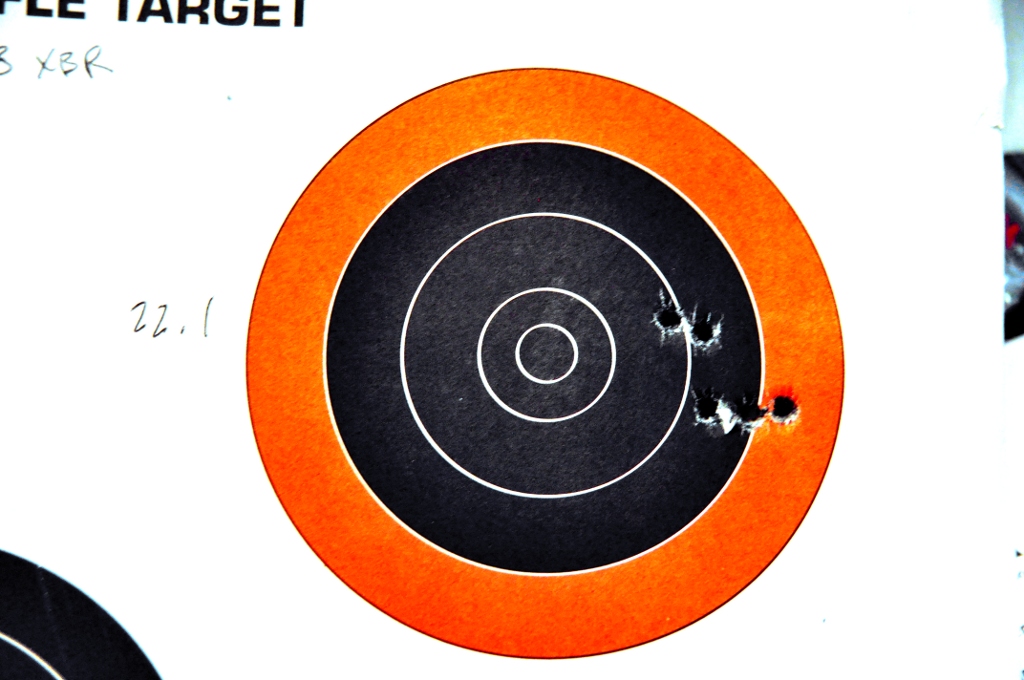
I did another workup using the 70gr using the 8208 XBR powder as well. Accuracy was good, but velocity was a little lower than I'd wanted in a hunting round. I may be able to push the charge a bit to get the velocity I want, I'll have to see. The best groups were at 22.1 and 22.7 grains, with average velocities of 2542 and 2610 fps, respectively.


Finally, I decided to try out Vhitavuori N135 with the 55gr bullets, at the suggestion of TxGunGeek. I ordered this powder along with the afore-mentioned bulk buy. I did a wide range for my workup, since I've never worked with the powder before. TxGunGeek uses a charge of 25.6 grains for his accuracy load, though our rifles are certainly different in configuration. I ran the whole gamut and came across a beautiful gem of a grouping at 24.7 grains of 7/16"! I'm quite impressed with the results using this powder so far.


I didn't get a reading from the chronographfor this string because it was getting dim out and I stopped getting readings about this time. Judging from the readings around this group, I'd say it was moving around 2950 fps. Not too bad for a plinking load. Next session, I'm going to run some of these at 100y and see how they do.

Monday, January 31, 2011

.223 handload workups

It was a nice day at the range today. A bit windy as usual there, but otherwise it was nice shooting weather.

As mentioned a couple posts ago, I'd worked up loads with a few different powders and a couple of different bullets. I got the chance to take them out to the range today to see how they ran. I got a bunch of 5-target sheets from Midway with my last order. These utilize five 3 15/16" bullseyes on cheap newsprint-quality paper. They're very inexpensive, so are great for testing load workups.

I had two powders I did workups with for the Winchester 55 grain FMJ-BT bullet: IMR 3031 and Hodgdon Benchmark. I was surprised to actually find useful and accurate loads in both powders.

I'd not had a lot of faith in IMR 3031, as the key benefit of the powder when it was sold to me is that it burns clean. That is a nice characteristic, but certainly not the primary factor for me when choosing a powder. Using the Lee manual as a guide, I made a workup from 23.0 to 24.8 grains, in increments of 0.3 grains. The top end of this is a compressed load. I don't understand the dynamics of compressed loads very well, other than the fact that some powders don't work well with compression, while others do. OAL for this set was 2.230".

I had the chronograph out and had my spotting scope handy to see the results of my work. I made my way through the 3031 group, not seeing anything particularly notable as far as grouping size was concerned. I did see that my shots were grouping a little low and left, so made some adjustments just before the last group of the batch. I ended up over-adjusting and pulled the second shot, which hit a little too high and ricocheted off the bottom edge of the top post above my target. This caused all sorts of nasty tearing on the target, and I figured it didn't matter much, considering the performance of the powder up to this point. I finished up the string and moved on.

I brought all my targets home for review, going through the data for each one. I saw that the last string of the IMR 3031 showed a much tighter spread and Standard Deviation than the rest. Average velocity was 3089.05 with a spread of only 53.33 and a SD of 20.17. I went and looked at the target, and in the mess of the ricochet, found the rest of the shots in a 1/2" grouping!


I think I may do a little tuning work with this powder and explore the top end to see what I find. This was definitely a surprise!

The Benchmark workup performed well. I did a workup from 24.0 to 25.5 grains, in increments of 0.3 grains. Data was based on the Hodgdon load, with OAL adjusted to 2.235" from the 2.220 that was listed for a soft point. It looks like the accuracy sweet spot is somewhere around 24.9 grains at an average velocity of 2982.89. Consistency here was good as well, with a spread of only 37.53 and a standard deviation of only 14.59. Grouping was around 1".

Moving on to the hunting load workups, I created workups for both powders mentioned above, as well as with Ramshot TAC, which I've heard good things about in conjunction with the Speer 70 grain Semi-Spitzer.

I started out with the IMR 3031 loads first. This workup was based on the loads from the Hodgon website, and ranged from 19.0 to 21.1 grains with OAL set to 2.150". Grouping was OK, but nothing below 1.5". The best group also had very tight velocities, with an average of 2430.11 fps, a spread of only 9.77 fps and a standard deviation of only 4.35. Looking at the data overall, the powder stayed very consistent throughout the workup. I may work on this powder a bit and see if an adjustment to OAL makes any difference in grouping. They definitely need to be stoked hotter to hit acceptable velocities for hunting - the highest velocity I got out of this workup was 2503 fps.

Next was the Hodgdon Benchmark. This workup went from 20.8 to 22.6 grains, with an OAL of 2.150". I actually got a nice 3/4" group with my starting string, but grouping seemed to progressively open up the higher the velocities got until the last group, where they tightened down a little. The high end of this workup only got up to around 2650 fps. Velocity consistency was actually very similar to the 3031, with extreme spreads generally staying around 25, more or less.

Finally, I tried out the revamped Ramshot TAC loads. While Ramshot only publishes .223 loads (which seem overstated in velocity), they have data for 5.56 NATO spec as well. I found someone who'd put this information up on their site after corresponding with Ramshot, so I gave it a try. The listed range (for 68 grains) starts at 23.5 grains up to a max load of 26.2 grains. I picked up just above where I left off, and started at 24.0 grains, with 0.3 grain increments. I'd run low on these bullets, so only had enough for 20 rounds. Since this were NATO-spec charges, I used Lake City brass instead of the the Prvi Partizan or Federal .223 brass I have been using for most of my loads. Grouping tightened up at the top end of my workup, and I got about 1" at 24.9 grains. OAL was set to 2.155" The 24.9 grain group gave good results for velocity, with an average of 2814.45 fps with a spread of 20.15 fps with a standard deviation of 9.53. Once I get some more bullets ordered, I'm going to do another workup with this powder and increment by 0.2 grains and get a little higher that I did with this set.


It looks like TAC is in good shape for becoming my hunting load powder, so I'll keep you posted here.

I also promised a re-evaluation of the S&B 5.56 ammo that I picked up at Cabela's. I had some extra time at the end of my workup tests, so I figured I'd put 10 more rounds through the rifle to see how it measured up this time around. Results were significantly better, with about 1 1/2" grouping, excluding 1 flyer.


That's all I've got for you now. I'll keep you posted on new development efforts.

Tuesday, January 18, 2011

.223 Range Tests

In previous posts, I've mentioned that I'd worked up some loads using Hodgdon Varget for the AR. From personal experience and from searching around on the internets, I've come to learn that Varget isn't really the ideal powder for this caliber. Results were OK, but both my 55 grain FMJ-BT and 70 grain Semi-Spitzer Soft Point loads have fallen short of what I'd hoped they would yield. I've read that Varget works relatively well for heavier bullets. The 70 grain loads I developed did perform better than the 55-grainers, but still not nearly as good as I wanted.

So I went and got a few powders to try out. I'd gone to the local gun shop in a rush after work to pick up some Hodgdon Benchmark and Ramshot TAC. Unfortunately, they were out of the former and didn't even carry the latter. At the suggestion of the clerk, I picked up some IMR 3031. He claimed it is good stuff for an AR, and it's "real clean". I grabbed a pound of it and made my way down to the register just before they closed the store.

Availability of load data for 3031 is a little thin, but there are loads in the IMR/Hodgdon/Winchester load data for the powder with both of my bullets, so I had a starting place. Still wanting to get the other two powders, I ran down to Cabela's and picked up a pound of the Benchmark and TAC. Benchmark seems to be made for .223 and similar rounds, and there's plentiful data out there for it. TAC is a little less common, and not all of my books have data for it. I'm primarily interested in TAC for a hunting load paired with the 70 grain Speer bullet, and I've read of others getting very good results with this pairing.

I worked up 55 grain loads for both Benchmark and 3031, and 70 grain loads for all three powders. TAC is supposed to be better for heavier bullets in .223, so I didn't bother with the 55-grainers using that powder.

So, I got everything ready to go to the range on Monday, got out there, and realized I'd left all of my workup loads at home with the exception of the TAC. Dammit.

To assist in my reload testing, I'd gotten a Caldwell Lead Sled Solo. I have also put a Nikon Monarch VSD on my rifle, of which I'll give my initial impressions in a post soon. I also used my Shooting Chrony Gamma Master to check the velocity and consistency of the loads. Once I got used to the lead sled rig, I ran through my TAC workup using 3" black bullseyes at 50y. My test workup used 5 rounds for each charge weight, and grouping was quite good. All groups were within 1.5", with some coming in well under an inch. This is using a 1x red dot, and I think these loads would have given even better grouping had I used magnified optics. I did the workup on the conservative side, and the lower end came in at 2369fps, not the ideal velocity for a hunting round. Ramshot's numbers should indicate that load at more like 2700fps out of a 24" barrel, which is a bit too much loss going out of a 16" barrel to think that barrel length is the only factor. I have a feeling they're taking the Hornady approach and over-stating their loads to keep people from loading too hot. I'm going to redo this workup, shifting to the higher end of their recommended loads to see what that produces, possibly this weekend along with the rest of the workups I forgot at home.

Since I had lots of time and no workups to test, I decided to test some of the factory loads I had on hand.

First up: UltraMax .223 62 grain FMJ. This stuff has been showing up in the gun shops at a very affordable price. It is commercially reloaded ammo using Lake City and WCC 5.56 brass. I took this stuff out to the range last trip as well, and was disappointed at the performance using iron sights and no support. I thought I'd test it out on the lead sled using the red dot to see what I could get out of it. Results were still disappointing. Pictured below is what I got on an 8" Dirty Bird target at 50y. I ran this through the chronograph as well, and quickly found that this was some seriously inconsistent stuff. Extreme Spread was nearly 300fps! At the price, this is good stuff for plinking around at steel in relatively close courses, but definitely not something you want to use if accuracy or consistency is important.


Next up, I tried my Winchester 55 grain FMJ-BT handloads using Varget (since I still have a bunch of them) to see what they gave me. Grouping was OK at around 1.75", but like I said - not good enough for what I want.

My last trip to Cabela's, I noticed they had some S&B 5.56 55 grain "M193" ammo on sale for $8.99. I picked up a few boxes to see how they'd run. While not nearly as spread out, grouping was not much better than the UltraMax mentioned above. Velocity variation and clustering was much better though, so this may have been in part my fault. Right around this time I realized my riser picatinny rail had worked itself loose (DOH! All my fault, really - my home allen bit kit apparently lacks a 7/64" size, so I'd gingerly tightened the bolts on with pliers at home), so that likely had to do something with it. I got vertical grouping of around 3", but horizontal grouping was only around 1.5". I borrowed an allen wrench from someone else and got my rail all tightened up. I'll have to give the ammo another whirl on the lead sled and see what it does.

Next came the surprise of the day, PMC Bronze. This is another 55 grain load in .223 that was on sale at Cabela's for $8.99. I grabbed a few boxes to test out, and figured I'd put them through rifle just to see how they did. Being cheap ammo to start with (it's only $9.99 when not on sale), I didn't expect spectacular results. I was quite surprised to see the target when I peered with the spotting scope. There's one flyer there, but got a 1.25" grouping otherwise. Big surprise! I may be stocking up on this stuff for my non-reload plinking ammo in the future. I'll be interested to see how well the brass works for reloading.

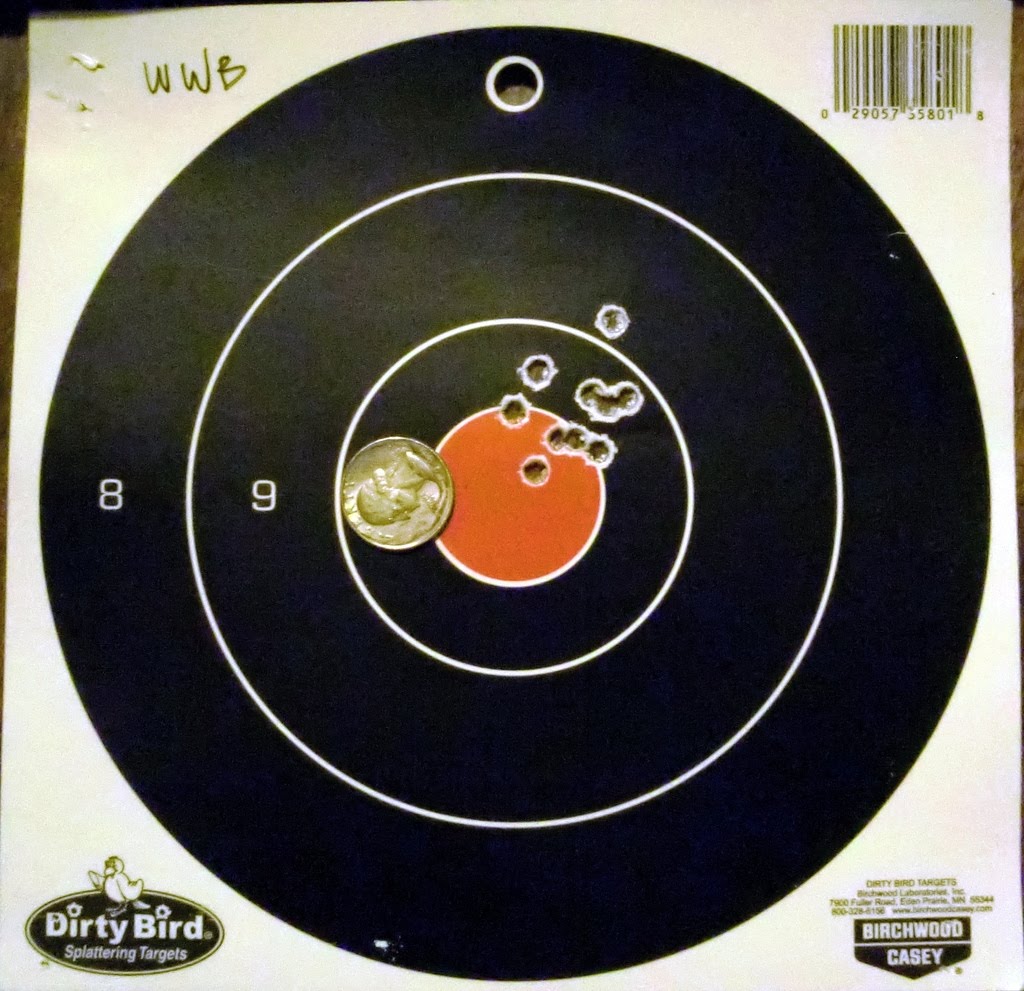
And finally, there's the WWB Q3131A1 mentioned in an earlier post. As expected, this ammo performed quite well. Aside from one flyer, I got sub 1" grouping with these rounds. Excellent stuff, and this affirms my earlier comments that this is one very nice commercial plinking round. The shelves were bare of the stuff (and marked as a "Best Seller!") during my trip to Cabela's, so I'm apparently not the only one that thinks highly of the stuff.

Anyhow, that's all I've got for you right now. Expect an update in the near future with my initial impressions regarding the Nikon Monarch VSD.

Wednesday, December 15, 2010

Brief Range Report - Winchester Q3131A1

A couple of months ago, I bought some Winchester 5.56 ammo at Cabela's to try out in the new rifle. It was on sale for $9.99, so I figured I'd pick up several boxes. I'd kept it in the range bag the first session I took the rifle out.

I decided to see how it performed the next session (in late November), and was pleasantly surprised at the vast improvement in my group sizes from the AE223. I'd shot a couple of targets using the AE223 at the beginning of the session, and was less than impressed at the grouping I got. Shots were all over the target. I certainly could attribute some of this to my ongoing issues with shooting iron sights against black targets, but they still didn't seem to reflect the consistency of my sighting. It was so bad, I didn't bother keeping or taking photos of the targets.

I loaded up some of the Winchester rounds and put 10 rounds through one of the targets that I was shooting with the AE223, and saw an immediate improvement. I loaded up a full mag of 30 and put 3 shots through that same target, then decided to move on to a fresh target, pictured below.


Excluding the two fliers at 1:00 and 9:00, that is a 1.5" wide and 2" tall grouping. This ammo seems to shoot *very* well in my rifle, certainly better than my ability to keep the rifle steady on target. On that subject, I just purchased a sling for the rifle, which should vastly improve my ability to steady my shots and improve my consistency. Just trying out the sling at home, I can tell a significant improvement in my ability to keep the rifle steady. I look forward to using it at the range this weekend.

I've also been able to work out both the plinking and hunting rounds mentioned in my last post. I've loaded up 200 of the plinking rounds using Winchester 55 grain FMJ-BT bullets, so I can see how well they run in numbers. I've got 50 rounds of the hunting load using the Speer 70 grain semi-spitzer soft point, to get a good feel for the load and its characteristics at different ranges. It looks like I won't get a hog hunt in this year, but an early 2011 hunt is possible. Hopefully, I'll get to put this load to some practical use in the near future.

Hopefully, I'll have something new to write up for you after the weekend.

Sunday, November 14, 2010

Rolling My Own...

I've been meaning to get a reloading post up for almost a year now. I just happened to be working up some .223 loads for the AR, so now seemed as good a time as any.


My reloading journey started 11 months ago, when I was given a Lee 50th Anniversary reloading kit by my mother-in-law as a Christmas Gift. I'd been working towards getting into reloading for some time, but had never got around to getting outfitted yet.

I started my foray into reloading with 9mm, as that's the caliber I get the most range time with. I've since developed several loads, using Blue Dot, Power Pistol, and Titegroup.


With .380 so difficult to find and expensive when you did find it last year, I decided that .380 would be a great way to save some serious money reloading. I've found, using recovered brass, that I can put together a box of 50 rounds of .380 for $5.84 in component cost. It's a great thing to not be held hostage to the poor selection and high prices of factory-loaded .380. If I need .380, I can simply load some up and have it ready whenever I need it. Not only that, but I've been able to tune my loads for accuracy, and am able to make groups I never thought possible out of my Ruger LCP.


Today was my first time reloading rifle cartridges. This is a somewhat more involved process than loading handgun rounds. Case lube is required for resizing, powder is manually funneled into each case in the loading tray (there is no expanding die to put the powder through with rifle rounds), and bullet seating is a little more tricky if you're not using boat-tail bullets.


I managed to get two sets of loads worked up, one as a standard 55 grain FMJ-BT plinking round, where I'm going strictly for accuracy. The other is a hog/deer hunting round, built with the Speer 70 grain Semi-Spitzer. I'll have to see how these run through the AR, as it has a 1:9 twist rate. From my reading on the subject, this may or may not be enough to stabilize a 70 grain bullet. The Speer website claims 1:10 or better is sufficient for stabilizing this bullet, so I think I should be good to go. We'll see when I try them out.

If all goes according to plan, I'm going to hit up the range tomorrow with the chrony in tow and see how these loads run. Hopefully, I'll have an update for you tomorrow night with the results.

Monday, November 1, 2010

AR Build - Range Report

After successful completeion, I took the AR out for its inaugural range session yesterday. I went to Best of the West Shooting Sports in Liberty Hill, the same range used for the LaRue Tactical range day event earlier in the month. The short-range rifle spots are 50, 100, and 250 yards. I wanted to zero the rifle for 200 yards, and 50 yards is at about the upward trajectory intersection of zero for a 200 yard zero AR, so I decided to run at that range. Unfortunately, all of the 50y target boards were in use, so I hung around and talked to the Range Officer and some other guys having a conversation until some space cleared out.

Finally, space did clear up, and I stapled up 3 8-inch "Dirty Bird" targets in a vertical row. I loaded up some of the American Eagle "Tactical" AE223 55grn FMJ rounds I picked up on sale at Cabela's into one of the PMAGs, and chambered a round.

To be honest, the first shot was quite anti-climactic for me. I went with the heavy barrel for several reasons, one of which was to keep movement and rise to a minimum for faster followup shots. This was much more effective than I anticipated, and my first impression of recoil was more akin to that of my Marlin 60 than any centerfire rifle I'd ever fired. Nonetheless, it was quite satisfying to shoot a gun that I'd put together with my own hands for the first time.

On to zeroing in the rifle, after several shots I finally figured out that I was hitting the dirt about 18 inches both high and right. I adjusted my windage and elevation, and finally started getting my hits on paper. I went through about 70 rounds getting zero and checking consistency. This was compounded by the fact that I was sighting with a flat black front sight against a black target. I'm considering tipping my front sight with bright white or perhaps a flourescent green to solve this problem. Please feel free to give suggestions or advice in your commentary.


Anyhow, I finally got a 2.5" group in my last string of 20 shots on the zero target, so I moved on to a clean target. I'm a bit disappointed in the size of the grouping, but I'm pretty certain this is related to the black-on-black sighting issue. Excluding the flyer outliers at 12:00, 9:00, and 6:00, this is a 3.5" group. I think that once I remedy the sight issue and get more accustomed to AR iron sights, I can easily cut that into less than half.

As an aside, I'd like to make positive mention for the Best of the West Shooting Sports range. This is a great place with a great staff. During my zeroing, my front sight tool broke off all its prongs, and I was stuck. The Range Officer happily offered up his tools for me to use, and I was able to finish my vertical adjustments and finish zeroing the rifle. What's more, is that I went through 100 rounds of .223, but came back with around 350 cases. Not only does this range encourage you to pick up your own brass, they're quite happy if you pick up brass left by other shooters as well. This is in stark contrast to the policies of most ranges who claim your brass as their own as soon as it touches the ground. I've got the cases in the tumbler right now, and hopefully I can crank out a couple of batches of .223 sometime this week. I need to develop some hog-hunting loads using the Speer 70grn semi-spitzer bullet sometime in the next month.

The gun performed well, though I did hit one hiccup in the middle of zeroing. Over the period of about 40 rounds, the trigger pin walked itself to the right side of the receiver, completely detaching from the left. This became evident when a trigger pull did nothing. I cleared the gun and pulled the upper off, and was able to fix the problem quickly. My best guess is that I pushed the pin past the detent during assembly, so that the spring was not able to retain it in place. The problem did not repeat itself for the next 6o rounds, so I think this was a simple assembly fluke. I'll take a closer look at it sometime this week to be sure.

Saturday, July 24, 2010

Blogger, reloaded.

I'd start off this post with some sort of apology for my absence, and promises that I'll do better to keep up with a more regular schedule... but I won't. I've been busy with life events and whatnot, and my downtime has been utilized for other purposes.

"What life events?", you ask?

Well, I got married. After 4 1/2 years (or thereabouts) of dating and engagement, we finally made the commitment of marriage to one another. I am glad to have done so.

Since the beginning of the year, I've picked up a couple of new activities to occupy my time.

First is reloading. For Christmas last year, I received a Lee 50th Anniversary Breech Lock Challenger Kit from my now Mother-in-Law. In short, this is a single stage reloading press (including all the fixin's except dies) with some pretty useful features. I started out with 9mm, as it's by far the caliber I shoot the most (and had collected the most brass for). I've since expanded to .380, .38 Special, and 9x18 (Makarov). I hope to add .45 ACP and .223 in the near future, but that depends on my acquisition of firearms in those calibers. An AR build is already in the works, which I'll document here as I go along.

I'll have several posts in the future about my reloading activities and experiences. Expect some to be bullet, powder, or caliber-specific.

Secondly, I've taken up fishing. I'm certainly not very good at it yet, but I've got friends to help me along. I really want a boat to fish in, however that requires storage space that a (non-bachelor) apartment simply doesn't provide. My bride tells me a house is required. I'll have to get cracking on that one. Anyhow, as I mentioned, I'm not terribly good at fishing yet. It's an enjoyable activity, and certainly beats sitting around the house.

I'm sure there's plenty I'm leaving out here, but that will have to wait until later. I'll try to get another post up later in the day.